
Can AI replace a Therapist? | Expert Advice
 Dr. Sheri Jacobson
February 28, 2026
Dr. Sheri Jacobson
February 28, 2026
By Stefan Walters – Psychotherapist & ADHD Coach
In an era where we turn to ChatGPT for everything from coding to cooking recipes, a new question has emerged: Can AI help us heal?
As AI apps for mental health gain popularity, many are wondering if the role of the traditional therapist is under threat. Stefan Walters, a specialist in Systemic Therapy and Brainspotting at Harley Therapy, argues that while AI might be a helpful “entry point” for those wary of human connection, it lacks the biological and emotional architecture required for deep healing.
Here are five reasons why the future of therapy remains fundamentally human.
1. The Power of “Rupture and Repair”
It sounds counterintuitive, but one reason your therapist is better than an AI is that your therapist is fallible.
AI is designed to be “correct” and provide concrete facts. However, real-world relationships aren’t perfect. In therapy, when a therapist misunderstands you or makes a mistake, it creates a “rupture.” The process of acknowledging that mistake and fixing it – Rupture and Repair – is a crucial life skill. It models how to handle disagreements and misunderstandings in your outside life, building a resilience that a “perfect” machine simply cannot replicate.
2. Containment in Time and Space
Trauma often leaves people feeling “disembodied” or dissociated. Time bleeds together, and memories feel scattered.

The physical therapy room and the strict boundary of a 50-minute session provide what psychologists call containment. This boundary orients the nervous system in space and time, creating a “safe container” for difficult emotions. AI is available 24/7 on your phone, offering no boundaries and, therefore, no true containment.
3. The Need for a “Challenge,” Not an Echo Chamber
AI is a sophisticated mirror; it often echoes back the answers you are looking for based on the data you provide.
A human therapist, however, acts as a “secure attachment figure” who can gently push you outside your comfort zone. Through exposure therapy and gentle confrontation, a therapist encourages you to see things in a new light.
Growth happens when we are challenged, not when we stay in an AI-generated echo chamber.
4. The Biological Need to be Witnessed
From infancy, our brains are wired for dyadic gaze – the experience of seeing and being seen by another human. This “witnessing” is physiological; it builds our sense of safety and orientation in the world.
Stefan describes AI as “supercharged Wikipedia.” While it can offer information, it cannot witness your pain. It isn’t in the room with you. Our nervous systems are primal; they know the difference between a simulation and a soul.
5. Healing is Embodied, Not Cognitive
This is perhaps the most vital distinction. Healing is an emotional discharge, not an intellectual understanding. AI can analyze the words you type, but it cannot feel them. Deep change occurs when we stay with somatic (body-based) feelings- sometimes sitting in long periods of silence to allow the nervous system to “reset.” AI cannot sit in silence with you. It cannot track the subtle shifts in your physiology that a trained Brainspotting practitioner or EFT therapist can.
“AI can offer you answers, but it cannot offer you an experience.” — Stefan Walters
About Stefan Walters
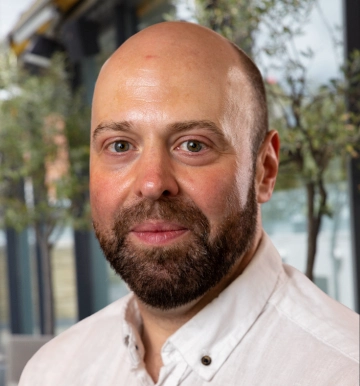 Stefan Walters (MSc, BSc, AFT) is a Systemic Psychotherapist, ADHD Coach, and Certified Brainspotting Therapist at Harley Therapy. With a background in the NHS and training from San Diego State University, Stefan specialises in addiction, trauma and relationship recovery.
Are you ready to experience the power of human-led healing? Book a session with Stefan Walters.